Evolution of Airbnb’s Microservice Architecture
Airbnb’s move from a Rails monolith to service boundaries shaped by team ownership.
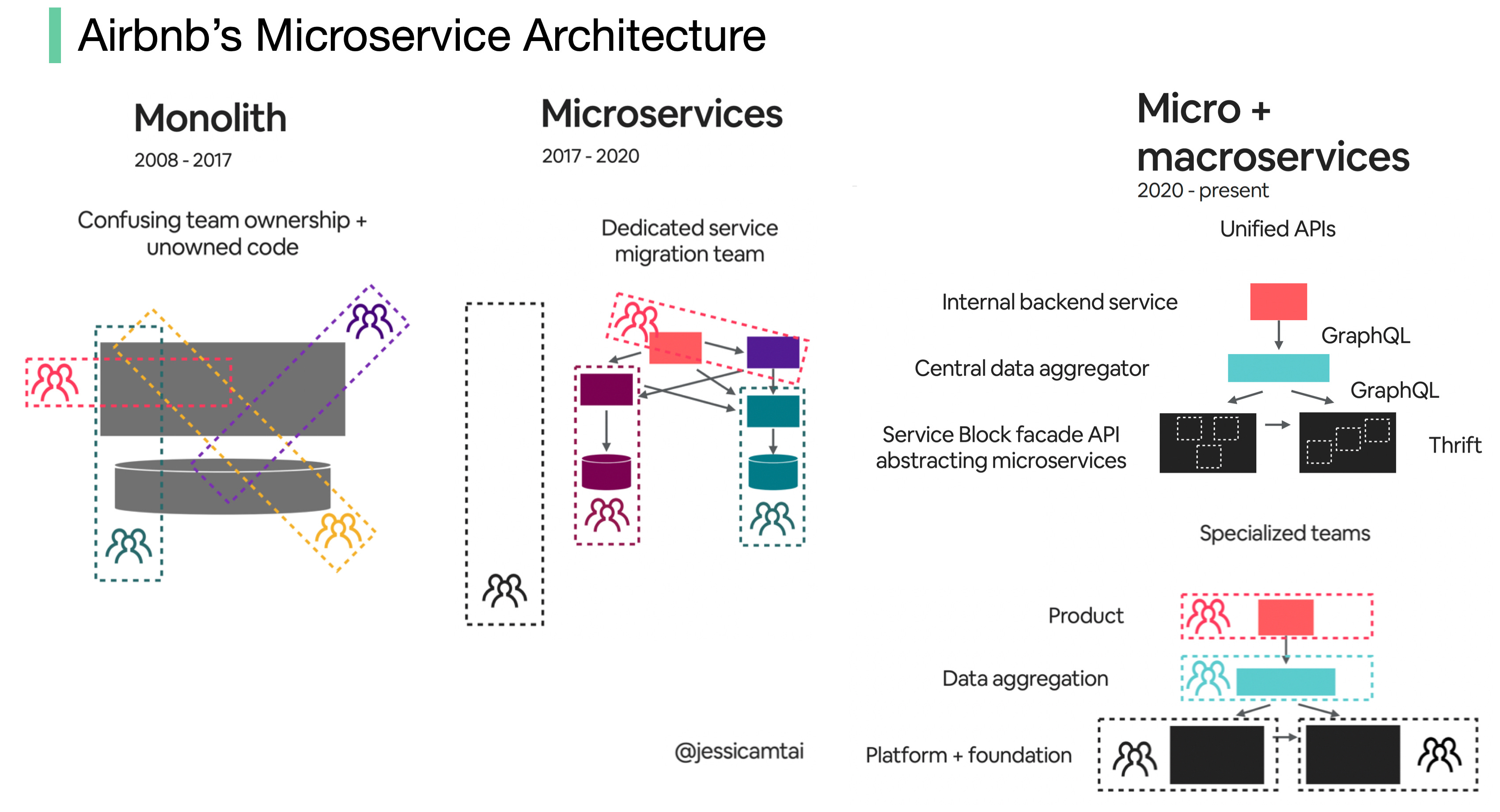
Airbnb’s architecture did not move from monolith to microservices because the monolith was technically incapable. It moved because the organisational cost of change became higher than the runtime cost of keeping one codebase.
From 2008 into the mid 2010s, a Ruby on Rails monolith was a sensible choice. Product teams could ship host, guest, booking, payments, and trust features inside one deployment unit with shared models and one relational database. That gives strong local consistency and low coordination cost when the company is still discovering the product. The weakness appears later. As more teams touch the same controllers, models, and background jobs, ownership gets blurry. Engineers stop knowing which changes are safe, deploys become slower, and a bug in one area can block unrelated work everywhere else.
The first important mechanism in Airbnb’s transition was not “split by service” in the abstract. It was “split by ownership and rate of change”. Teams needed boundaries they could reason about, with code they could deploy without waiting for every other team. That leads naturally to service-oriented decomposition: a data fetching service to assemble read-heavy views, business logic services to enforce domain rules, write workflow services to coordinate state changes, and UI aggregation services to present a stable interface to clients.
That design changes the failure model. In the monolith, many failures are in-process exceptions or bad database writes. In a microservice estate, failures become distributed: timeouts, retries, stale reads, incompatible schema changes, and request fan-out. A booking page that once called methods inside one process may now depend on several remote services. If each hop adds a little latency, the tail gets expensive quickly. If one upstream slows down, downstream teams inherit the incident even when their own code is healthy.
This is why microservices solve one human problem while creating another. They improve team autonomy, but they increase dependency management. Service boundaries produce API contracts, deployment pipelines, ownership maps, observability needs, and versioning concerns. Hundreds of services are difficult for people to navigate, especially when business flows cross domain boundaries. A service graph that looks clean on a whiteboard can become operationally noisy in production: duplicated logic, circular dependencies, and debugging sessions that require half a dozen teams.
Airbnb’s later move towards a hybrid of microservices and macroservices is best understood as a response to that sprawl. A macroservice is not just a bigger microservice. It is a deliberate aggregation boundary that hides many fine-grained internal services behind a domain-shaped API. Instead of letting every client or product team know the full topology, the macroservice provides a smaller surface area and a clearer ownership model. That reduces request fan-out, centralises policy, and gives humans a place to reason about end-to-end behaviour.
The tradeoff is real. Macroservices can become mini monoliths if they absorb too much logic or turn into approval bottlenecks for many teams. They need strong interface discipline, otherwise complexity simply moves up a layer. But for a large company, that compromise is often practical. The lesson from Airbnb is not that monoliths are bad, or that microservices always win. It is that architecture has to match both system scale and team scale. The painful part is usually not raw throughput. It is the number of people, dependencies, and cross-cutting changes the system asks them to manage.